

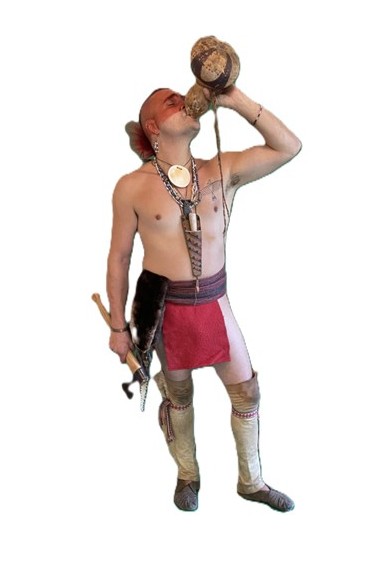
NAHC, Mapping Early New York 3D Model, Drew Shuptar-Rayvis, all rights reserved.
“For it makes us caches, that is, crazy”
Alcohol trade among Algonkians during the early Colonial period.
(Drew Shuptar-Rayvis 2025/26)
After the first voyages returned from the Eastern Coast of the New World, marvelous tales were told in the busy ports of Europe. In the dimly lit and crowded taverns, sailors, explorers, and sea captains told of men and women clad in the furs of wild beasts, extending their hands with riches and strange oddities from the New World. Once aboard ship, the Indians, curious about these outsiders, desired from them all sorts of objects made from glass and iron—materials they had never known before.
Word came back that these Indians, often referred to as Wilden (wild men), would trade thick furs of beavers, wild cats, deer, or muskrats for small trifles and truck, these being knives, colorful glass beads, hawk bells, awls, nails, files, axes, fishhooks, mouth harps. The Wilden considered more expensive goods such as brass and copper kettles, duffels, shirts, and other articles of European clothing to be so valuable that they could be traded for many furs or even tribal land. Even in this early period of exploration and colonization, Europeans were curious as well about these Indigenous people: Where did they come from? Where do they live? What language do they speak? Who are their leaders? What do they look like? What do they eat and drink? This last question especially becomes very telling.
Though Europeans brought with them many goods that were beneficial to Algonkian people, they also brought things that were not, the most notable being alcohol. Very quickly Europeans learned that the Indigenous people of North America had no alcohol of their own and no tolerance for it. Even small quantities of alcohol had incredible intoxicating effects on the American Indians. Europeans catching wise that these Native people when sober, were short of word and shrewd in their business, found that they became much more “pliable” when intoxicated. Manipulation ensued, with European fur traders taking advantage of American Indians of the Eastern Woodlands.
Indians could easily become addicted to these intoxicating spirits, trading anything for bottles and sometimes even gallons (often referred to by the unit of measure called an anker) of spirits. The traders knew this and utilized it to their advantage. Colonial governments also caught on to this addiction and often awarded alcohol as compensation to Indians during treaties, land sales, and court cases. At times, alcohol was legal tender and a valuable commodity that could be used to pay debts, both public and private. However, many court cases ensued in which the Indians complained about the trade in alcohol, which their Elders saw as destructive to their youth. Petty disputes over bad trade deals involving alcohol led to murders and violence on both sides. Some Europeans spoke out against the trade, but the commerce in alcohol was far too valuable for the words of these men to be fully heeded. This legacy from the Colonial period can be seen as one of the the roots of today’s issues with alcoholism in American Indian communities.
We may never know when alcohol first touched the lips of an Eastern Woodland person, but we can get close. Fortunately, the writings of Johannes Heckewelder (1743-1823) have survived. In the mid- to late eighteenth century, Heckewelder served as a Moravian missionary among the Western Delaware people (Lenape). In his 1818 book, History, Manners and Customs of the Indian Nations, he recounts a story told to him by members of his congregation about and encounter with a man they believed to be Henry Hudson, whom they called the mysterious “Man in Red” because of the cloak he was said to wear.
In this account, the Western Delaware regaled Heckewelder about how Henry Hudson and his men were the first to give them alcohol, in 1609: “Chiefs and wise men, assembled in council, form themselves into a large circle towards which the man in red clothes approaches with two others. He salutes them with a friendly countenance, and they return the salute after their manner. They are lost in admiration; the dress, the manners, the whole appearance of the unknown strangers is to them a subject of wonder; but they are particularly struck with him who wore the red coat all glittering with gold lace, which they could in no manner account for. He, surely, must be the great Mannitto, but why should he have a white skin? Meanwhile, a large Hackhack (a Lenape word meaning gourd but used to describe a glass alcohol bottle or decanter)is brought by one of his servants, from which an unknown substance is poured out into a small cup or glass, and handed to the supposed Mannitto, He drinks—has the glass filled again, and hands it to the chief standing next to him. The chief receives it but only smells the contents and passes it on to the next chief, who does the same. The glass or cup thus passes through the circle, without the liquor being tasted by any one, and is upon the point of being returned to the red clothed Mannitto, when one of the Indians, a brave man and a great warrior, suddenly jumps up and harangues the assembly on the impropriety of returning the cup with its contents. It was handed to them, says he, by the Mannitto, that they should drink out of it, as he himself had done. To follow his example would be pleasing to him; but to return what he had given them might provoke his wrath and bring destruction on them. And since the orator believed it for the good of the nation that the contents offered them should be drunk, and as no one else would do it, he would drink it himself, let the consequence what it might; it was better for one man to die, than that a whole nation should be destroyed. He then took the glass, and bidding the assembly a solemn farewell, at once drank up its whole contents. Every eye was fixed on the resolute chief, to see what effect the unknown liquor would produce. He soon began to stagger, and at last fell prostrate on the ground. His companions now bemoan his fate, he falls into a sound sleep, and they think he has expired. He wakes again, jumps up and declares, that he has enjoyed the most delicious sensations, and that he never before felt himself so happy as after he had drunk the cup. He asks for more, his wish is granted, the whole assembly then imitate him, and all become intoxicated. After this general intoxication had ceased, for they say that while it lasted the whites had confined themselves to their vessel.” (1)
Very soon after Hudson’s alleged encounter, Europeans caught on to the intoxicating effects and novelty of alcohol among Eastern Woodland peoples. By the mid-seventeenth century it had become very apparent that alcohol was a problematic trade good and powerful commodity in the Indian trade. Adriaen van der Donck, a Schout (Dutch legal representative and company lawyer) for the Dutch West India Company, wrote about Indian alcohol use and abuse in his book, A Description of New Netherland, which was published in 1655, the year of his death.
Van Der Donck was a man well acquainted with the customs, language, and manners of the Indians of the Lower and Upper Hudson Valley. He says of the fare and foods of the Indians: “Their usual drink has always been water, from a fountain or spring if they can get it, as they seldom fail to do. When they are will provided, they will occasionally drink grape juice, if it is in season, with fresh meat or fish. They drink the juice fresh and never turn it into wine. Beer, brandy, or strong liquor are unknown to them, except to those who frequently move among our people (the Dutch) and have learned that beer and wine taste better than water. The Indian languages are varied and rich, yet none has a word denoting drunk. Drunkenness they call madness, and to drunken men they refer as fools, such as those few who associate often with our people or are otherwise able to obtain liquor, for most of them have no taste for liquor at all. In order to prevent insolence, the government has forbidden the sale of strong drink to them. They drink greedily in getting drunk and are then just like Saint Valentine in his cups, as the saying goes. Before they become accustomed to alcohol, they are easily made drunk, a small beer ( a 17th century light alcoholic drink that was the common drink for working people) or two being enough to do it. But in time they learn to tolerate liquor equally well as the Netherlanders do.” (2)
It became very well known that the Indians could become unruly or violent when drunk. Van der Donck writes that this affliction was so novel to them and their society that there was no word to describe drunkenness, let alone a societal norm or expectation of how to handle it when it happened. In Dutch documents we find what is likely a Munsee dialect word, “Caches/Cacheus,” which means “crazy;” this term appears repeatedly in both Dutch and English documents from the period. Eastern Woodland people are usually very forgiving of drunkenness, saying that it was not the man that committed the act, but the alcohol that caused him to do it. Alcohol's ability to unleash uninhibited aspects of violence among Algonkian people, shows up clearly in the middle seventeenth century conflict known as The Esopus Wars (1658-1663). Though there were many causes of this conflict, alcohol and drunkenness among the Indians, has always been cited as one of the most documented.
Early in the conflict of the Esopus war (1658), Peter Stuyvesant (c. 1610-1672) met with Esopus sachems, asking them why they had committed violence in the frontiers of the Upper Hudson River Valley. Their response was as follows:
“Stuyvesant asked the Esopus through his translator Jacob Jansen Stoll to explain why they had carried out “murders, arson, killed hogs and did other injuries and continually threatened the inhabitants of the Esopus. ”Then one of the sachems stood up and said in reply that the Dutch sold the bisson, that is brandy, to the Indians and were consequently the cause that the Indians then became cacheus, that is crazy, mad or drunk and then committed outrages; that they, the chiefs, could not control the young men, who then were spoiling for fight; that the murder had not been committed by one of their tribe, but by a Neuwesinck Indian, who was now living at Haverstroo or thereabouts; that the Indian, who set fire to the houses, had run away and would henceforth not be permitted to cultivate his land. As far as they were concerned, they had done no evil, they were not angry nor did they desire or intend to fight, but they had no control over the young men.” (3)
Even in the Esopus’s own words, which we are so fortunate to have, they loudly decry alcohol as the problem. It disrupts their systems of governance and, when intoxicated, makes what were wise and sensible men and dutiful warriors into terrors and monsters who could not be controlled, or whose angers could not be quelled. Though van der Donck says that the liquor trade has been outlawed, this was clearly superficial and not enforced. Alcohol was too valuable, and too readily available to the Europeans, to curtail as a trade commodity with the Indians in any significant way.
Trouble involving alcohol did not exist only in the north, around the Hudson River and its River Valley, it followed the Dutch to their colonies to the south on the Delaware River and Delaware Bay in the colony of New Amstel (today New Castle, Delaware).
New Amstel was the political center of the South River settlement and also one of the largest hubs of trade in the Delmarva Peninsula region. Governed by the controversial Alexander D’Hinojossa (c. 1629-1672) from 1659 to 1664, complaints of drunkenness among the Indians and mentions that the illicit sale and trade of alcohol were prolific, causing numerous problems in the settlement. Some of these court cases were able to be arbitrated, while others, sadly, were settled through violence.
Renowned cultural anthropologist and archaeologist C.A Weslager, in his book Red Men on the Brandywine, recounts some of these cases: “On January 8, 1657, Laurens Pieters was summoned before the Council at New Amstel to explain why five Indian men, two women and a boy had been observed drinking beer at his place contrary to regulations, Pieters said the beer had been sold them by another, and that the Indians had actually purchased three water-pails full which made them intoxicated and insolent.A month later a neighbor accused Marten Roseman of selling wine to the savages. On November 6, 1659, one of the officials wrote of “The great noise made by drunken savages," and six intoxicated Indians were found near Jan Juriaen Becker's house. When the Dutch attempted to arrest them, the Indians escaped to the woods, returning later to steal a musket and two blankets. Becker was accused of selling brandy to the Indians as he had done to the Dutch garrison at Fort Altena and Fort Amstel. Two drunken soldiers had burned a canoe belonging to the Indians "whereupon the savages threatened to set fire to a house or kill some cattle." During the same month Peiter Mayer met an Indian in the woods who had a two-quart measure of liquor which he had bought from Becker. "The savage requesting him to sit down and drink with him, he did so at different. times. Next morning this savage was found dead a little farther into the woods, the can [read bottle] with a little liquor in it lying near him; whereupon the savages threatened Johannis, as they call him, with death. They say that he poisoned the savage." As a warning, the Indians placed the corpse of their tribesmen on a hurdle opposite Becker's house, to curse the place where he had purchased the liquor.In his defense, Becker insisted that since he had previously held a post in the government, the Indians looked upon him as a sort of chief, often bringing him a goose, duck, deer or turkey as a present. He confessed that "in return for which, it is true, the defendant never hesitated to give or present them a drink of brandy, but that only to such Sachems as Mecheck Schinck, Wechenarent, Arewee-hingh, and Hoppaming, etc." .” pages 36 and 37
Even government officials, who were meant to uphold laws that prohibited the sale of alcohol to Indians and were believed to look after the Indians’ general welfare, were fingered for willingfully breaking the law and disregarding the serious effect of alcohol on Indian lives. Weslager writes: “On May 25, 1660, the following accusation was made about, D’Hinojossa, one of the Dutch officials at New Amstel: "Monsr. Kip and other have told me at different times that since a long time ago no regard whatever is paid by Mr. D’Hinojossa to the sale of strong drinks to the savages, so that they run about with it in day-time and commit many nuisances and discharge their guns near the houses in the evening and out of season."D'Hinojossa was not very sympathetic to the Indians, and when two white men murdered an Indian man, woman and boy from "the damnable desire of wampum," he discharged the two murderers.”
A surviving letter to Peter Stuyvesant, Director General of New Netherlands Colony sent by Alexander D’Hinojossa in June of 1660 from New Amstel, gives us an exaggerated, or unfortunately horrifyingly accurate image of the wild and lawless nature that was pervasive in the frontier trading town of New Amstel: “In the meantime I cannot omit to inform your Honor that I see many drunken savages daily and I am told that they sit drinking publicly in some taverns. On the 14th inst. When I went with Capt. Jacop and Mons. Schreck to the house of Foppe Janssen to salute Mr. Rendel Revel who had come overland from Virginia, while we were there several drunken savages came before the windows so that it was a disgrace in the presence of strangers. Likewise, our soldiers and others have told me that the savages had an entire anker of anise-liquor on the strand near the church and sat around it drinking. One Gerret the Smith also came at the same time complaining he lives in the back-part of the town near the edge of the forest and says that he is very much annoyed by drunken savages every night, he has spoken of it several times to Mr..D’Hinojossa but has not received any assistance, he says, he will be obliged to abandon his house.” pages 37 and 38
The question remains: why did the Dutch not enforce these laws? They were clearly aware of the destructive nature of alcohol among the Indians. They constantly complain about the killings and legal incidents caused by drunkenness among both the Indians and the settlers. Would their problems not have been resolved if the Dutch had decided to cut the trade of alcohol entirely? The answer to this quandary is quite simple: economics. Weslager tells us that in trade the Indians would settle for nothing else, and the Dutch figured, who were they to refuse to oblige them? Why hinder the wheels of economy from turning? The lives of Indigenous peoples in the Americas and their welfare as human beings were never the heart of the issue, they were a consideration. Economics was the primary desire of colonial Europeans and maintaining a system where forest products could be bought and sold for whatever goods were available, was the end all and be all–the ultimate goal. If that then caused the desolation of the Indians, then so be it; D’Hinojossa certainly was able to turn a blind eye.
Weslager again emphasizes that economics interest was a key reason the trade continued, even when laws were in place that were openly and flagrantly disregarded: “The deponents further know that if the poor inhabitants of the Colony of New Amstel and others did not sell or barter liquor to the savages for Indian corn, meat or other things, they would perish from hunger and distress."If further evidence is needed that the Dutch officials. participated in the barter of liquor, it is found in the following request made by one of the officials on the Delaware“I need also 2 ankers of brandy or distilled water to barter it next month for maize for the garrison, as it is easier obtained for liquour than for other goods.” (4)
William Penn (1644–1718), the proprietor of the colony of Pennsylvania which once encompassed much of what is now Delaware, also wrote extensively about American Indians. Penn, being a Christian theologian and friend of Indigenous Americans, was concerned about their use of alcohol and its effects on their society. In 1683 he wrote a letter to the Committee of the Free Society of Traders in that province residing in London, he writes “Since the Europeans came into these parts, they (the Indians) are grown great lovers of strong liquors, Rum especially, and for it exchange the richest of their skins and furs: if they are heated with Liquors, they are restless till they have enough to sleep; that is their cry “some more and I will go to sleep”; but when drunk, one of the most wretchedest spectacles in the world.” (Page 6 , reference 5)
Like van der Donck, Penn recounts how the Indians regarded drunkenness as a form of insanity, saying: “Tis rare that they fall out, if sober; and if drunk, they forgive it, saying, it was the drink, and not the man that abused them,” Referring to the former Colony of New Sweden and parts of New Netherland (lands now under Penn’s control), he describes their shortcomings and writes: “They (the descendants of Swedish and Dutch colonists now residing in Pennsylvania) are plain, strong, industrious people, yet have made no great progress in culture or propagation of fruit trees, as is they desired rather to have enough, than plenty or traffick. But I presume, the Indians made them the more careless, by furnishing them with the means of profit, to wit, skins and furs, for Rum, and such strong liquors.” (5)
Numerous writers in the seventeenth century demonstrate that alcohol was a problem in American Indian communities. Consistently they show that Europeans knew alcohol was a problematic trade good because Indigenous North Americans had no native alcohol of their own and no societal means for dealing with drunkenness. The fact that its trade was, on a surface level, to be “curtailed” or “outlawed” was just that. Through the records of court cases of legal or illicit alcohol sale, it can easily be shown that there was no real desire on the part of Europeans to enforce these rulings. The Dutch and other Europeans were complicit in this devastating trade and knew it would make Native Americans “compliant” in trade and especially in land agreements.
Why were Europeans so shocked that Indigenous Americans had no alcohol of their own? What made alcohol so important in their culture and economy?
In the Old World, which encompasses Europe, the lands of the Fertile Crescent, and Asia, alcohol existed in some of these regions as early as the Neolithic period (10,000-4,500 BC). Among the earliest alcoholic beverages were beer, made from wheat and barley, and honeyed beer known as mead, along with wine, made from grapes and fermented beverages from rice. So integral were these early alcoholic beverages that they show up as key rations, dietary staples, gifts, objects of religious rites and key elements in community identity and storytelling among some of the earliest cultures including the Egyptians, Sumerians, Greeks, Hebrews/Israelites, and Chinese. In Northern and Central Europe, prior to Roman occupation and colonization, Indigenous European tribal communities were known for their love of beer, especially the honeyed beer, called “ mead.
Though mead may have lost its popularity by the late Middle Ages, Central and Northern Europe has retained its ancestral love and propagation of other forms of beer and alcoholic spirits to this day. Beer— particularly “small beer,” with its very low percentage of alcohol, provided Europeans with a safer drink, since water was not always reliable. Small beer also provided essential B vitamins and had a high nutritional value that kept people healthy in times when fresh vegetables were not readily available. Besides providing vitamins, small beer was easy to manufacture and was a staple in Dutch households for all meals and occasions.
Alcohol has always been laborious to make. For beer, wheat or barley must be grown, harvested, threshed, and ground and then mixed with boiling water and yeast to carefully ferment and produce an alcoholic drink that, for many, tastes good. A similar process of manufacture can be said of wine, as well as drinks made from agricultural crops such as apples, pears, and peaches. Due to the laborious nature of alcohol production, in the Old World it was viewed as a valuable and taxable commodity. When colonial Europeans arrived in the New World during the seventeenth century, they brought with them their love and technology of brewing, vinification and acetic fermentation which creates things such as vinegar, a staple in Dutch diets.
Among the Dutch and Swedish colonists, we find the alcohol they prefer and bring for consumption and trade was beer, wine, and brandy. Brandy was made from the fallen, overripe and bruised apples, pears, peaches, and apricots grown in the New World from imported fruit trees. These fruits, which were not to be wasted, were perfect for brandy and hard ciders.
Among the English we find a similar love of beer, fortified wines from Spain and Portugal, such as Port and Madeira, but also a new drink, one that would have a heavy place in the New World: rum. Rum is an alcoholic drink made as a byproduct of the sugar industry. During the seventeenth century, rum was mostly produced in the Caribbean by slave labor and exported to English colonies around the world. Rum, by its nature is extremely sweet and was highly addictive, which made it more desirable by Native Americans who were not used to such concentrated sugar with a high alcoholic content. By the mid-1600’s when the English dominated the colonial scene, rum becomes the preferred alcohol of trade and legal proceedings among the Indians.
Colonial powers learned quickly that in legal arbitration with Indigenous North Americans, they must present gifts that symbolized friendship and alliance. These gifts included a large list of trade goods, but also alcohol. Colonial governments both English and Dutch learned that alcohol was one of the few objects Indians would accept without complaint and could be made “agreeable” by. English Crown law of the mid- to late- seventeenth century stipulated that terms such as land sales, treaties and other forms of legal arbitration with the Indians, must ensure that Indians are compensated fairly and are legally “satisfied,” meaning that the goods and terms were agreeable to them. If satisfaction was not achieved and terms not met, land sales, treaties, and arbitration could not proceed and were therefor void. Alcohol, in particular rum, shows up in numerous court documents throughout the mid- to late- seventeenth century and continues into the eighteenth century.
In 1686 a court case was held in Saint Mary’s City, in the English Colony of Maryland. The defendant was an Annemessex Indian man whose English name was “Ned.” Ned was under accusation for the poaching of beaver on patented land owned by an Englishman; in reprisal, the said Englishman had seized his beaver. Ned, however, due to treaty rights made with the colony, was within his rights to trap said beaver.
When brought to court in Saint Mary’s City, the court ruled in Ned’s favor and awarded him (through his arbiter Colonel William Stevens) one of forty bottles of rum. The rest of the bottles were to be issued to other Indian defendants. “Ned an Annamessex Indian complaines that one John Kirk and John Carter will not suffer their Indians to hunt upon their land and that Coll. Colebourne if they catch any beaver doth challenge the skinns, and they pray that noe new comers may be suffered among them.Resolved by the board to consider of what has been offered and to give the Indians answer to morrow. the satisfaction of the said Indians, and the peace and welfare of the Province, and that the bridge at the head of Pocomoke, and that at Nassawango or Askimenokonson Creeke, dividing Askimenokonson Neck from Nasswatax be better secured, by affixing at each end of both the said bridges a good and sufficient swinging gate, and that they the said Coll. Stevens &c. more particularly and diligently enquire into the Offence of Edward Hammond, as also into all Incroach-ments and other damages or grievances offered to the said Indians, and make their Report to this board at at the time of the next Provinciall Court for their further result.The Indians called in, and first the board renews to them their thanks for their present yesterday, and Testimony. of Friendship to his Lsp (lordship)then communicate to them the foregoeing Order passed in their behalfe, which they will take care to see Present to duely executed, and further order Coll. Stevens to the Indians.present them with forty bottles of Rumm for which they return thanks and are dismissed.At a Councill held at the City of S• Maries the eleaventh day of May Ann. Dom: 1686.”(6)
In the secondary source, Indians of Southern Maryland, by Helen Rountree and Rebecca Seib, the authors recount several court cases during the late seventeenth-century court cases involving communities of the Piscataway paramountcy in which alcohol was given either as a form of compensation or as a gift for signing treaties. Among the court cases, two stand out: “in July 1670 it came out that the Piscataway were trying to make their own peace with the Susquehannocks. The Piscataway speaker and two councilors met the English leadership, stating that their population was “now reduced to a small number” (probably an exaggeration) and that they wanted to “revive” (reconfirm) the 1666 treaty. To that the English were agreeable. The speaker went on to say that his people were innocent of a murder recently committed, but when the English asked to talk to the Tayac personally, the speaker told them that would be difficult to arrange because he was visiting the Susquehannocks. The English were probably not pleased at the news, but they ordered that the murder case be examined in the presence of three Indian observers, who would be given presents of Matchcoats (mantles made of woolen duffel cloth) and rum.” (page 98 reference 7)
Rountree and Seib also mention goods given during the signing of the Treaty of 1692, which reaffirmed the peace and amenity agreement of 1666: “Even with its flaws, though, the 1692 version was good enough that the Eastern Shore Pocomoke’s moved to make their own treaty the next October. If the last treaty did not indicate much of a cultural shift among the Indians, the presents exchanged at the time did. The Piscataway Tayac gave the governor raccoon skins, in return for which he received six coats, six shirts, six pairs of stockings (English woolen stockings), and six bottles rum for himself and his great men; the Mattawoman and Choptico chiefs got three of each” (7)
Farther north of Maryland, we often find alcohol included in land sales with local Indians. British Crown law stated that Indians were the natural inheritors of the land and that all land that was not patented must be purchased from them. The problem with the law is that it did not stipulate or specify who these Indians exactly were that they were owed compensation for the purchase. Many times, Europeans would pick any Indian or tribe and make a land sale with them whether the territory that was desired for purchase actually belonged to that community or not. This led to what now has now been dubbed “fraudulent” land sales, as the tribes whose homelands were being sold off, often said that these purchases were not done with them, but with others, or chiefs who no longer held political power or authority of representation.
Among the legitimate land sales is the 1683 purchase of Fishkill, New York, from the Wappinger Indians, a Munsee-speaking paramountcy indigenous to the Mid-Hudson Valley of New York. In History of Duchess County New York, a secondary source written by James H. Smith with assistance from Hume H. Cale and William E. Roscoe in 1882, the goods given are recorded as follows:
“"A Schedull or Perticuler of Money, Wampum and other goods Paid by francis Rumbout and Gulyne Ver Planke for the purchase of the Land in the Deed here- unto annexed
"One hund Royalls, One hund Pound Powder, Two hund fathom of White Wampun, one hund Barrs of Lead, One hundred fathom of Black Wampum, thirty tobacco boxes ten holl adges, thirty Gunns, twenty Blankets, forty fathom of Duffills, twenty fathom of stroudwater Cloth, thirty Kittles, forty Hatchets, forty Hornes, forty Shirts, forty p stockins, twelve coates of R. B. & b. C., ten Drawing Knires, forty earthen Juges, forty Bottles, forty Knives, fouer ankers rum, ten halfe fatts Beere, Two hund tobacco Pipes &c.,, Eighty Pound Tobacco."New York, August the 8th, 1683,"The above Perticulers were Delivered to the Indians in the Bill of Sale Men-coned in the psence of us"Antho. Brockhalls,"P. V. Courtlandt,"John West."I do hereby certify the foregoing to be a true copy of the Original Record. compared therewith by me."Lewis A. Scott, Secretary." (8)
Of the alcohol given to the Wappingers in exchange for the land, there were 40 ankers of rum and ten half fatts [vat in Dutch] beer. In the seventeenth century an “anker” was a unit of measure equal to about ten gallons; in total it can be said that the Wappingers were given roughly 400 gallons of rum and ten half-barrels of beer.
Of all the trade goods to enter North America, alcohol had the longest and the most painful effects. Though individual colonists and colonial governments complained profusely about its sale and its distribution among the Indians, attempts to control its sale by law were rarely enforced. Much of this was surface level. The fact of the matter stands: colonial powers understood that alcohol from its inception in Native society was harmful and could be used to manipulate Native people for gain. Europeans actions speak for themselves; alcohol was used to expand the colonial empire and addiction to alcohol insured native compliance in all matters of trade and agreements. Due to this weaponization, alcohol continues to be one of the most destructive substances in Native American communities to this day.
- John Heckewelder . History, Manners and Customs Of The Indian Nations Who Once Inhabited Pennsylvania and Neighboring States (Ayer Company Publishers 2005), pages 69-70.
- Adriaen van der Donck, A Description Of New Netherland (University of Nebraska Press 2008), ; “Fare and Food of the Indians,” pages 76-77.
- Franklin Eck, in collaboration with Dr. Paul Kelton (Stony Brook University, Undergraduate History Journal, 2020).
- C.A. Weslager, Redmen on the Brandywine (Hambleton Company Inc, 1953), pages 36-38.
- William Penn, A letter From William Penn, Proprietary and Governor of Pennsylvania in America to the Committee of the Free Society of Traders of that Province Residing in London, 1683 (Kessinger Legacy Reprints), pages 6-8.
- Proceedings of the Council of Maryland, 1684-89, pages 480-481.
- Rebecca Seib & Helen C. Rountree, Indians of Southern Maryland (Press of the Maryland Historical Society, 2014), pages 98 and115.
- James H. Smith, Hume H. Cale, and William E Roscoe, History of Duchess County New York: with illustrations and biographical sketches of some of its prominent men and pioneers (D. Mason & Co, Syracuse, NY, 1882), page 32.